
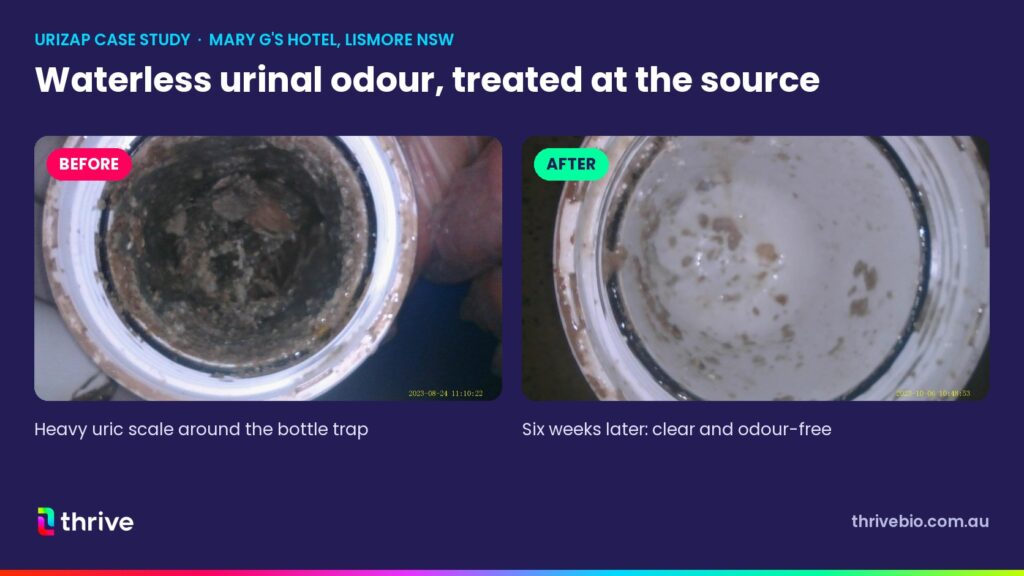
Mary G’s Hotel in Lismore, NSW, put in wall-mounted waterless urinals to solve a washroom odour problem and save water. The smell stayed, and so did the blockages, because the cause was uric scale built up around the bottle trap. In 2023, after an on-site assessment, Thrive recommended URIZAP. The general manager says the bad odour was gone after two weeks, and at six weeks the bottle trap was clear and odour-free with no manual intervention needed.
Key takeaways
- Waterless urinals remove the flush. They don’t remove the build-up in the trap and pipework, which is where urinal odour comes from.
- At Mary G’s, the cause was heavy uric scale around the bottle trap of the waterless urinals.
- After an on-site assessment, Mary G’s used URIZAP. At six weeks the trap was clear and odour-free, with no manual intervention needed.
- Treating the cause can mean fewer plumber callouts and less time spent on the washroom, while keeping the water savings the venue paid for.
Who should read this
This is for pub and hotel operators, venue managers and hospitality groups, especially anyone who has installed waterless urinals and still has a smell in the men’s room.
Why do waterless urinals still smell?
Waterless urinals save water because nothing flushes. But urine still runs through the trap and into the pipework, and it leaves deposits behind.
Uric scale is a hard, layered deposit that forms inside urinals and their pipes. It is a mix of mineral salts, limescale, uric salts, proteins and slime. It sticks to the trap and pipe walls, narrows the pipe and slows drainage.
Uric scale also causes the smell. Bacteria living in the scale use up the oxygen and start producing ammonia, the sharp, stale odour that hangs around a busy washroom. Cleaning the bowl doesn’t reach it, so the smell comes back after every clean.
A new fixture doesn’t change any of this. If the build-up stays in the trap, the odour and the blockages stay too.
The challenge at Mary G’s Hotel
Mary G’s is a large, popular venue in Lismore on the NSW Northern Rivers. It holds plenty of events, is busiest on weekends and is popular with local university students. In 2023, like the rest of the town, it was rebuilding and investing after the 2022 floods.
A venue that busy puts its washrooms under constant pressure. Mary G’s had ongoing odour and blockage problems with its urinals. Its most recent upgrade was wall-mounted waterless urinals, installed in the hope of solving the odour while saving water.
The problems continued. Strong odours were still coming from the bathrooms. When the bottle trap was inspected, it showed a heavy build-up of uric scale.
What did Mary G’s do?
Thrive met with the venue on site to look at the bathroom issues and recommended URIZAP.
URIZAP is a biotechnology urinal treatment. Beneficial bacteria break down the organic build-up that causes urinal odours and blockages, without caustic chemicals. One scoop a week keeps working after application, so urinals stay free-flowing between services. Allow 4 to 6 weeks for full results.
What were the results?
- After two weeks: the general manager says the bad odour was completely gone.
- After six weeks: the bottle trap was clear and odour-free, with no manual intervention required.
Camera photos of the bottle trap, taken six weeks apart, show the change: heavy scale before, and a clear trap after.
“I was sceptical at first because environmentally friendly products never work, but I was shocked that the bad odour was completely gone after 2 weeks”
Jeremy, General Manager, Mary G’s Hotel
What does urinal odour cost a pub?
A smelly washroom costs more than goodwill. The costs add up in four places.
- Plumber callouts. Blocked urinals usually mean a plumber. Australian plumbers charged an average of about $121 an hour in 2026, based on bids on ServiceSeeking, and work outside business hours often costs more.
- Staff time. Every extra clean, deodoriser change or trap check takes staff away from the bar and the floor. At Mary G’s, no manual intervention was needed by week six.
- Water. Toilets and urinals can account for up to 40% of a facility’s water use, according to Water Corporation WA. Waterless urinals cut that. Fixing the odour means a venue keeps the savings it paid for, instead of going back to flushing to hide the smell.
- Your pipework. Treating build-up without caustic chemicals avoids putting harsh products through the plumbing week after week.
To estimate the savings for your own site, try the Thrive savings calculator.
Why the usual fixes fall short
- Urinal cakes, blocks and sprays cover the smell for a while. They don’t touch the scale in the trap.
- Bleach and acid cleaners work on the surface of the bowl. The build-up that causes the odour sits further down.
- Rodding clears a blockage on the day. It is expensive, the scale soon builds up again, and rodding can damage plumbing.
- New fixtures change the urinal, not the pipework. Mary G’s found this out with its waterless upgrade.
How URIZAP fits a pub’s cleaning routine
- Dose: 1 scoop of URIZAP per urinal, then half a cup of water.
- Frequency: weekly, as part of the normal washroom clean.
- Timing: allow 4 to 6 weeks for full results. Mary G’s saw the trap clear at six weeks.
- Don’t mix: don’t use URIZAP with bleach, acid toilet cleaners, other concentrated liquid cleaners, or urinal cakes and blocks.
If your urinals are older, drain slowly or have very heavy scale, start with a 7-day course of URIZAP Shock. URIZAP Shock is a clean chemistry treatment for urinals with heavy build-up, strong odours or slow drainage. One scoop a day for 7 days breaks down established scale and deposits. Then switch to weekly URIZAP to keep urinals clear.
Drains in guest bathrooms build up in a similar way. See how a 400-room airport hotel dealt with blocked drains.
The bottom line
Waterless urinals are a good way to save water, but they won’t stop the smell on their own. Mary G’s Hotel treated the cause, the uric scale in the trap, and got its washrooms back to clear and odour-free within six weeks.
Talk to the Thrive team about your venue at sales@thrivebio.com.au or (02) 8379 2000, send us a message, or run the numbers on the Thrive savings calculator.
Frequently asked questions
Why do waterless urinals smell?
Waterless urinals smell when uric scale builds up in the trap and pipework. Bacteria in the scale produce ammonia, which causes the stale washroom odour. Cleaning the bowl doesn’t reach it. A treatment like URIZAP works on the organic build-up in the pipework, where the odour starts.
Can URIZAP be used on waterless urinals?
Mary G’s Hotel in Lismore used URIZAP on its wall-mounted waterless urinals. After six weeks, the bottle trap was clear and odour-free, with no manual intervention required. Waterless urinals come in different designs, so check with the Thrive team about URIZAP for your urinal type.
How long does URIZAP take to work?
Allow 4 to 6 weeks for full results from URIZAP. At Mary G’s Hotel, the general manager reported the bad odour was gone after two weeks, and the trap was clear and odour-free at six weeks.
What is the difference between URIZAP and URIZAP Shock?
URIZAP is a biotechnology treatment for weekly urinal maintenance. URIZAP Shock is a clean chemistry treatment for heavy build-up, used daily for 7 days. For urinals with very heavy scale, start with URIZAP Shock, then switch to weekly URIZAP.