
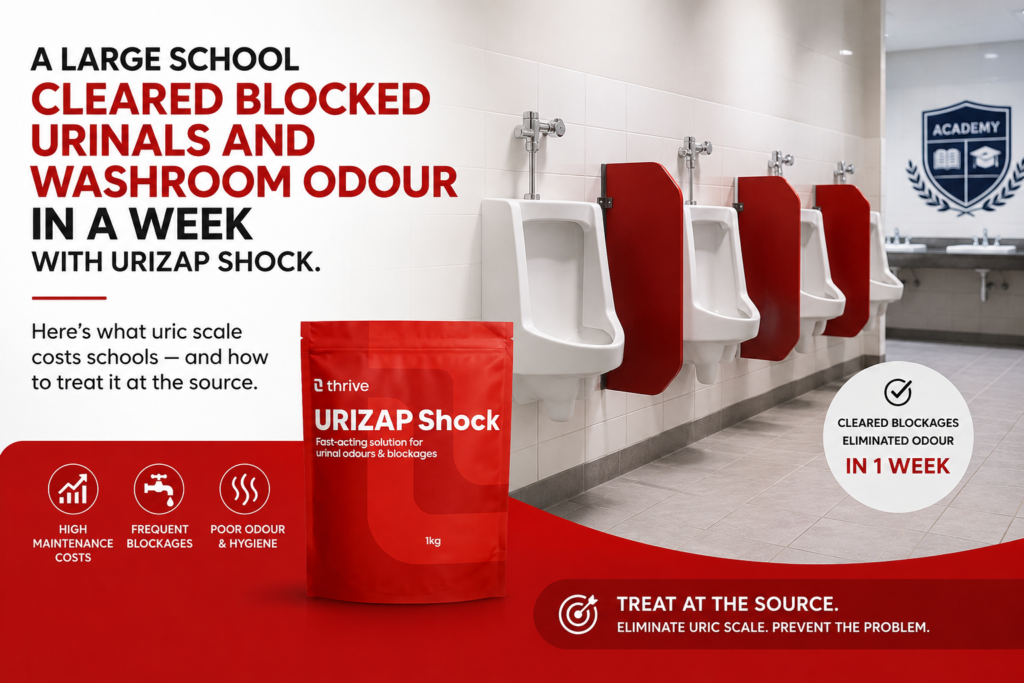
A large school campus had a washroom problem that no amount of routine cleaning could fix: persistent urinal odours, urinals blocking up, and years of uric scale build-up choking the pipework. The site, managed by a leading facilities management company, ran a 7-day corrective dosing programme with URIZAP Shock — one daily dose per urinal. Within days, blocked urinals were back to full flow, odours dropped sharply, and camera footage showed the uric scale breaking down at the source. Blocked, smelly school urinals are common — and costly — across Australia.
Here’s what was happening in the pipework, what it costs a school, and how a fast-acting urinal treatment fixed it without rodding or harsh chemicals.
Who should read this
This is for school business managers, facilities managers, councils, and the FM contractors who service education sites — anyone trying to keep washrooms usable and odour-free while holding a tight maintenance budget.
What causes blocked and smelly urinals?
The smell isn’t really a cleaning problem on the surface. It’s built into the pipe.
When urine sits in a urinal and its pipework, the uric acid in it reacts with minerals in the water and hardens into uric scale — also called struvite or “urine stone.” This crusty, mineral-like deposit clings to the inside of the pipe, especially at bends and the P-trap. Over time it narrows the pipe, slows the flow, and eventually blocks it completely.
Two things then go wrong at once:
- Odour. Uric scale is a breeding ground for the bacteria that release ammonia — that sharp, stale washroom smell. Standard cleaning wipes the surface but never reaches the scale in the pipe, so the smell always comes back.
- Blockages. As the scale builds, water backs up. A slow-draining urinal becomes a blocked one, and a blocked one becomes a flooding risk.
Schools are hit hard because their washrooms are high-footfall and used in tight bursts between classes. That constant pressure builds scale fast — and the usual response is to flush more often or call a plumber, neither of which removes the scale.
What the school did
The site was a busy education campus with multiple washrooms and high footfall from students and staff. The facilities management company faced four linked problems: persistent odours, blocked urinals that students couldn’t use, historic uric scale restricting flow, and an ongoing reliance on reactive maintenance and manual intervention.
The fix was a short, structured programme: URIZAP Shock, dosed daily for seven days, designed to break down uric scale, organic build-up and blockages at the source. It slotted straight into the existing cleaning routine with no disruption to the site.
The results, seen on camera and on site:
- Blocked urinals restored to full flow within days.
- A significant drop in odours.
- Visible breakdown of the uric scale and build-up in the pipework.
- Less reactive maintenance and fewer callouts.
- Easy dosing that the on-site cleaning team adopted quickly.
“The product works well… I’m very impressed.” — Contract Manager
What do blocked urinals cost a school?
This is where reactive maintenance quietly drains the budget.
The plumber bill. In Australia, commercial blocked-drain jobs commonly run $500 to $800 or more, and severe blockages can pass $2,000. After-hours and emergency callouts add another 20–50% on top. A campus with multiple washrooms, clearing blockages reactively across the year, turns that into a recurring cost.
Rodding and descaling that doesn’t last. Mechanical rodding and harsh acid descalers can punch through a blockage, but they don’t stop the scale reforming. So the callouts keep coming — you’re paying again and again for the same problem.
The labour. Every hour a cleaner spends on a smelly, blocked urinal — or waiting on a plumber — is an hour not spent elsewhere. Manual intervention on uric scale is one of the least pleasant, least productive jobs on a school cleaning roster.
The student experience. A washroom that smells or has urinals out of action is the kind of thing students, parents and staff notice and talk about. It chips away at how well-run the school looks and feels.
The water angle: why urinals quietly drain school budgets
Urinals are one of the biggest hidden water costs in any school.
To fight odour and blockages, flush rates are often turned up — and many urinal systems flush on a timer around the clock, even overnight and during school holidays when nobody is there. Older flushing urinals can use up to 10 litres or more per flush. Australian studies put the water saved by switching a single urinal to waterless at roughly 60,000 to 151,000 litres a year — a sense of just how much water flushing urinals get through.
This is where ongoing treatment pays off twice. Once URIZAP Shock has cleared the scale, transitioning to URIZAP for maintenance keeps the pipework clear and reduces the need for constant flushing — cutting both water use and water bills. Fewer blockages and less flushing is a double saving most school budgets would welcome.
An illustration of the long-term value: Thrive’s own modelled estimate for 100 urinals over three years puts the savings at around $54,000 in avoided plumbing costs, 396 labour hours recovered, 62 million litres of water saved, and 12,980 kg of CO₂ avoided. These are modelled figures for illustration, not results from this school — but they show the scale of what’s at stake when urinals are managed proactively instead of reactively.
Why rodding and harsh descalers aren’t the long-term fix
Traditional urinal fixes come with trade-offs:
- Rodding clears the blockage but leaves the scale behind, so it returns.
- Strong acid descalers (often sulphuric or hydrochloric acid based) can damage pipes, ceramics and seals over time, and are hazardous to handle and store.
URIZAP Shock works differently. It targets the uric scale and build-up at the source, is non-corrosive, and is designed to replace rodding, harsh chemicals and expensive pipe repairs. That protects the pipework you’re trying to maintain — instead of slowly wearing it out with every reactive fix.
From clear to staying clear
The school used URIZAP Shock to clear an established problem in a week. The bigger win is keeping it clear.
- Shock to clear. URIZAP Shock for seven days breaks down existing scale, build-up and blockages.
- URIZAP to maintain. Move to ongoing URIZAP dosing to keep pipework clear, prevent odours returning, and reduce flush frequency.
- Built into the routine. Simple dosing the cleaning team can run themselves — no special training, no site disruption.
Fewer callouts, less labour lost to manual intervention, no caustic damage to pipework, lower water use, and washrooms that stay usable. That’s the case most school and facilities budgets are working through right now.
Why this matters for Australian schools
The same problem plays out on Australian campuses every day:
- High-footfall school washrooms build uric scale the same way everywhere.
- Australian commercial plumbing costs make reactive urinal clearing an expensive habit.
- Water is a real cost and a real pressure here, especially in drought-prone regions — and flushing urinals are a major, often-overlooked source of waste.
For an Australian school or FM contractor weighing routine treatment against repeat callouts, wasted labour, high water bills and unhappy washroom users, getting ahead of the problem is the cheaper path.
The bottom line
A large school cleared persistent odours, blocked urinals and historic uric scale in about a week with a 7-day URIZAP Shock programme — restoring flow, cutting reactive maintenance, and doing it without rodding or harsh chemicals. For Australian schools facing the same high-traffic washrooms and tight budgets, treating uric scale at the source — then maintaining it — is a low-cost way to avoid the much larger cost of reactive plumbing, wasted water and out-of-action washrooms.
See what proactive urinal treatment could save your site. Talk to the Thrive team at sales@thrivebio.com.au or (02) 8379 2000, or run the numbers on the Thrive ROI calculator.
Frequently asked questions
What causes blocked and smelly urinals? Uric scale. When urine reacts with minerals in the water, it hardens into a scale (struvite, or “urine stone”) inside the pipework. It narrows the pipe, restricts flow, and feeds the bacteria that cause washroom odour. Surface cleaning doesn’t reach it, so the problem keeps coming back.
What is URIZAP Shock? URIZAP Shock is a fast-acting Thrive treatment that breaks down uric scale, organic build-up and blockages in urinals at the source. It clears blockages and odours within a week, is non-corrosive, and is designed to replace rodding, harsh chemicals and pipe repairs.
How long does URIZAP Shock take to work? The programme is one dose per urinal daily for seven days. In this case study, blocked urinals were restored to full flow within days and odours dropped significantly inside the week.
Is URIZAP Shock safe for pipework? Yes. It is non-corrosive, unlike the strong acid descalers and mechanical rodding often used on uric scale, which can damage pipes, ceramics and seals over time.
How much do blocked urinals cost a school in Australia? Commercial blocked-drain callouts commonly run $500 to $800 or more, with severe blockages exceeding $2,000 and after-hours fees adding 20–50%. On top of that sit recurring labour, repeat callouts when scale isn’t removed, and the water cost of constant flushing.
Sources
- Metro Rod — Uric Scale in Your Toilets Explained (Feb 2026)
- AeroWest — Toilet Scale Formation & Prevention
- J & J Plumbing Services — Average Cost to Fix Blocked Drains, Canberra (Dec 2025)
- Yellow Pages — Australian Plumbing Cost Guide (2026)
- ZeroFlush — How Waterless Urinals Drive Sustainability in Australian Buildings (Aug 2025)
- energy.gov.au — Water Efficiency (WELS)