
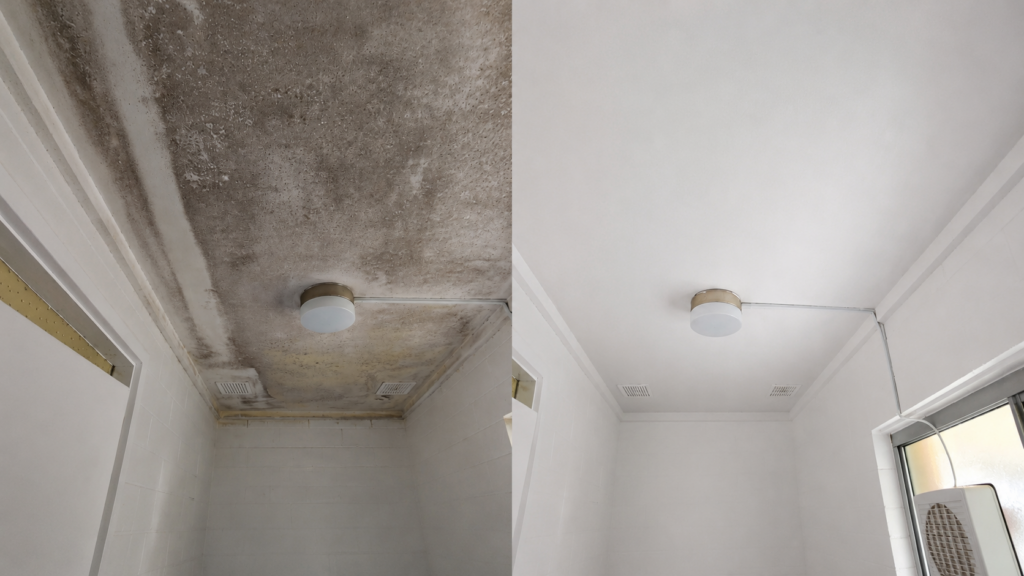
When a school discovers mould on a ceiling, in a storage room, or under a sink, two decisions follow. The facilities manager approves the job. The remediation contractor picks the product. Most attention goes to the first decision. The second one is where the real cost is set — labour hours on site, damage to the surface underneath, repeat callouts, and how quickly the room can be reopened.
This article looks at what one Australian remediation contractor with 23 years in the field is choosing now, why they switched, and what it means for the facilities team writing the cheque.
Key takeaways
- The product the remediation contractor uses determines the real cost of the job — labour hours, surface damage, callbacks, and room downtime.
- UniTek Services in Forster NSW, with 23 years of experience, now puts Thrive’s MOULDZAP at the top of the list.
- MOULDZAP outperforms hydrogen peroxide on stubborn staining without bleaching or damaging the surface underneath.
- For schools, the right product cuts labour cost, prevents surface damage, reduces reactive callouts, and avoids the jump from a small clean-up to a full Category 2 remediation.
The decision chain on a school mould job
Three parties shape the outcome of a school mould job.
The business manager or facilities manager approves the work, signs the contract, and owns the budget line. The remediation contractor chooses the method and the product, does the work, and signs off. On larger jobs, an occupational hygienist is engaged to verify that the area is safe before students and staff return.
The product decision sits with the contractor. The cost sits with the facilities team. That gap is why one short conversation matters so much. Ask your contractor what they are using and why.
A 23-year verdict from a NSW contractor
UniTek Services is a certified cleaning business based in Forster, NSW. It serves commercial and residential property across the Mid North Coast — carpet cleaning, upholstery cleaning, stain removal, and mould remediation. Director Matt Jones has been doing this work for 23 years.
After testing many products in the field, UniTek now puts Thrive’s MOULDZAP at the top of the list. Matt Jones explains the choice in plain terms:
“I have recently integrated Thrive MOULDZAP into my mould abatement services with outstanding results. The product demonstrates a high level of efficacy across a wide variety of surfaces, proving to be a versatile asset in the field. MOULDZAP offers a much more efficient way to remove stubborn staining that traditional hydrogen peroxide products often struggle with. The result is a visibly cleaner and brighter surface, achieved with significant labour savings.”
— Matt Jones, Director, UniTek Services
His reasoning is operational, not promotional:
- Outperforms hydrogen peroxide on stubborn staining
- Significant labour savings on every job
- No toxic fumes, no risk of damage to the surface underneath
For a school, those three lines translate directly to less time on site, fewer repeat visits, no ruined ceiling tiles or carpets to replace, and rooms back in use without an extended ventilation period.
Why hydrogen peroxide often falls short
Hydrogen peroxide is the default “safer” mould chemistry. It is widely promoted as eco-friendly because it breaks down into water and oxygen and produces no chlorine fumes. That is true at the lab bench. On a real job, the limitations stack up.
It bleaches surfaces. Hydrogen peroxide has a documented bleaching effect on wood, fabrics, paint, and some plastics. Spot tests are needed every time.
It struggles on porous materials. Plasterboard, paint, ceiling tiles, carpet, and wood are common in schools. Peroxide does not reliably penetrate deep enough to kill mould at the root, and it can discolour the material on the way through.
It stops working once dry. No residual action. The moment moisture returns — and on a school site, moisture rarely stays controlled for long — re-colonisation begins.
It does not neutralise mycotoxins. The most hazardous mould by-products can remain after the visible mould is gone.
It irritates skin and stings eyes. Operators need PPE; concentrated formulations need more.
On stained porous surfaces, the failure pattern is consistent. The contractor applies the product, scrubs, and the visible stain partly lifts. Streaking remains. The school sees a half-finished result, so the contractor goes again — sometimes with stronger product, sometimes with damage to the surface itself. The one-visit job becomes two. Labour cost doubles. Someone absorbs that cost.
MOULDZAP was designed to solve exactly that failure pattern.
What MOULDZAP changes
MOULDZAP is a probiotic microbial cleaner. It contains no chlorine. It is pH-neutral. The active mechanism is competitive exclusion — beneficial microbes consume the organic material that mould feeds on and crowd out re-colonisation at the surface. The cleaner keeps working after the visit, not just during it.
Surfaces it works on:
- All bathroom surfaces, walls, and ceilings
- Painted and papered plasterboard
- uPVC and timber window frames
- Carpets, curtains, and upholstery
- Damp and water-damaged areas
How a job runs on site:
- Fill a trigger bottle with warm tap water to the marked line.
- Add the contents of one MOULDZAP sachet. Shake for 60 seconds — the liquid turns blue.
- Rest 5 minutes. If the blue colour remains, shake again.
- Once the blue fades, the product is ready to use.
- Spray onto affected surfaces. Leave for 15 minutes.
- Wipe off excess moisture with a dry cloth. No scrubbing required.
One sachet makes up to 5 litres of working solution — the same as ten 500 mL trigger bottles of ready-to-use cleaner. Lightweight, compact, lower freight cost, smaller storage footprint, less plastic. The formula is 100% biodegradable. The bottle is reusable post-consumer recycled plastic. Sachets are home compostable.
What this changes on the cost line
Mould is one of the most expensive lines a school facilities team can absorb. Indicative Australian remediation pricing in 2025–2026 ranges from a few hundred dollars for a small surface job to tens of thousands of dollars for a Category 3 remediation with containment. Treating the mould properly the first time protects every dollar above that line.
The cost benefits of MOULDZAP on a school job sit in four places.
Labour savings. Fewer passes on stubborn staining. Significant labour reduction is the outcome UniTek Services reports in the field.
No surface damage. No bleaching, no fading. No replacing ceiling tiles, repainting walls, or replacing carpet that the cleaner itself damaged.
Fewer reactive callouts. The microbial action keeps working after the visit. Re-colonisation slows. Rooms that used to come back on the maintenance log every few months stop coming back.
Avoided full-remediation jumps. Treating stained surfaces early — before the moisture has worked its way through the plasterboard — avoids the jump from a $2,500 cleaning job to a $7,500+ job that includes material replacement. According to published Australian remediation sources, around 60–70% of a Category 2 mould project cost is moisture rectification, not the mould removal itself. Keeping the mould job in the surface-cleaning category protects the rest of the spend.
The same logic applies whether you run one school, a multi-campus federation, or a mixed estate that includes early-learning, after-school care, and TAFE space.
Mould in Australian schools is not theoretical
NSW Department of Education has publicly notified mould remediation works at multiple sites in recent years.
At Sydney Secondary College Balmain Campus, mould was identified on a food tech room ceiling in mid-2023. The room was cordoned off, an independent occupational hygienist was engaged, surface cleaning and air scrubbing were carried out, and the affected ceiling sheet was replaced. The works ran across the July school holidays.
At Willyama High School in early 2024, severe heat and humidity over the school holidays produced mould across multiple buildings. A specialist contractor was engaged, again under the supervision of an independent occupational hygienist. Each space was environmentally cleaned, air-monitored, and cleared before being released back to the school.
These are reactive maintenance events — the most expensive category of work in NSW Department of Education’s own framework. The pattern is consistent: humid weather, closed-up buildings, condensation, and within 24 to 48 hours mould has established on damp organic material.
Around 1 in 13 school-age children has asthma. Mould is one of the indoor triggers facilities teams are expected to manage. Lower-quality remediation does not just affect the wall — it affects the children and staff who use the room next.
What facilities teams can do this term
You do not need a major procurement cycle to act on this. Three short steps.
One. Ask your remediation contractor what they are using. If the answer is hydrogen peroxide or chlorinated bleach, ask how they handle stubborn staining and re-colonisation. The conversation itself is the test.
Two. Request a sample MOULDZAP sachet to test on a known issue on site. Real surface, real conditions — that is the test that matters. We will ship one to you.
Three. For larger sites or multi-school portfolios, run the numbers. Use the cost calculator at calculator.thrivebio.com.au to estimate the cost-per-bottle and the storage saving across your sites.
The cost of mould is not only what shows up in the remediation quote. It is the re-callouts, the surface damage, the rooms held off-line, the impact on students and staff with asthma, and the time the facilities team spends managing all of it. Choosing a contractor who uses the right product cuts every line of that cost.
Frequently asked questions
Is MOULDZAP safe to use in occupied school spaces?
Yes. MOULDZAP is chlorine-free, pH-neutral, and 100% biodegradable. The formula releases no toxic fumes during application, which means no extended ventilation period after the work is done. Operators do not need respiratory PPE for normal use. Rooms can be returned to use as soon as surfaces are dry.
How does MOULDZAP compare to hydrogen peroxide for mould remediation?
Hydrogen peroxide works as an oxidiser — it kills surface mould at one moment in time, then stops working once dry. It also bleaches some surfaces and struggles to penetrate porous materials like plasterboard, paint, and carpet. MOULDZAP works by competitive exclusion. Beneficial microbes consume the organic material that mould feeds on and keep working after application. On stubborn staining on porous surfaces, MOULDZAP typically clears the stain in fewer passes than hydrogen peroxide and does not bleach the surface underneath.
Can MOULDZAP be used on carpets and ceiling tiles?
Yes. MOULDZAP is safe on carpets, curtains, upholstery, painted and papered plasterboard, uPVC and timber window frames, and damp or water-damaged areas. Spot-test on an inconspicuous area first if the surface finish is unknown.
What does MOULDZAP cost?
MOULDZAP is supplied as a concentrated soluble sachet. One sachet makes up to 5 litres of working solution — the same as ten 500 mL trigger bottles of ready-to-use cleaner. That cuts cost-per-dose, freight, and storage relative to liquid alternatives. Run your site numbers on the cost calculator at calculator.thrivebio.com.au.
How quickly does MOULDZAP work?
Spray onto the affected surface, leave for 15 minutes, then wipe off excess moisture with a dry cloth. No scrubbing is required. On stubborn staining, a second application may be useful but is rarely needed.