
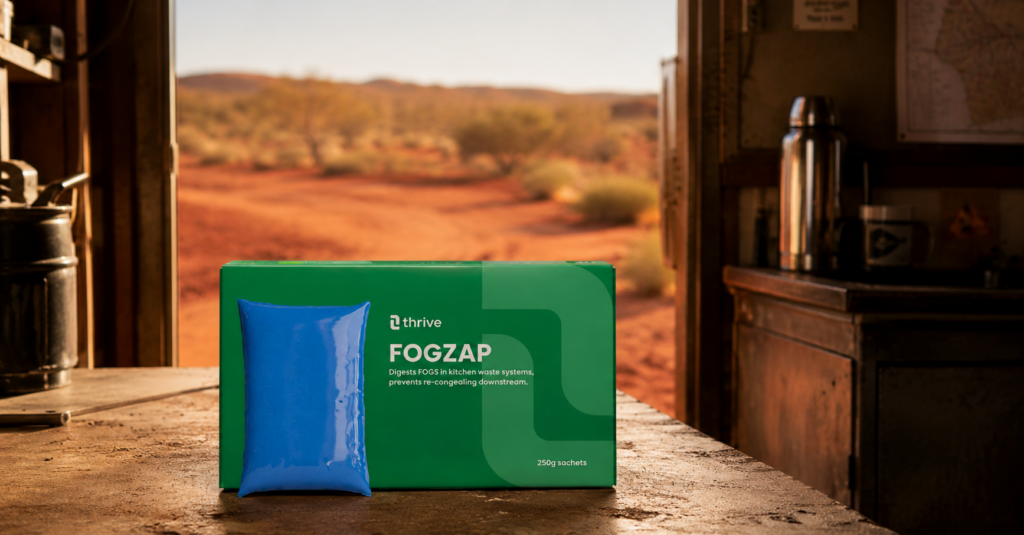
A blocked grease trap in the city is a phone call. The same grease trap 900km from the nearest contractor is a logistics project — mobilisation fees, dangerous-goods freight, and a long wait while the odour sits next to a dining hall.
That distance penalty is the quiet, structural problem with remote-site maintenance. The default reactive model — wait for the fault, then mobilise a fix — was designed for places where help is close. Remote mining operations don’t have that luxury.
Rosslyn Hill Mining proved an alternative works. Their Paroo Station Lead Mine, an open-cut lead carbonate operation 900km north-west of Perth, replaced reactive grease-trap pump-outs with FOGZAP — a probiotic treatment that uses bacteria to digest fats, oils and grease (FOG) continuously, between site visits. Here is what changed, why an accidental staff changeover proved it works, and what it means for any operation maintaining infrastructure at distance.
Why reactive maintenance fails at remote mining sites
Mining accommodation villages run the same infrastructure as any hospitality venue — kitchens, washrooms, grease traps, wastewater systems. What they don’t have is the logistics environment that makes reactive maintenance affordable. Three things compound at distance:
- Every callout is multiplied. A pump-out or plumbing visit that’s routine in a metro area becomes a planned logistics exercise at a remote site — mobilisation fees, travel time, scheduling around site access, all priced accordingly.
- Chemical resupply is a liability, not a routine. Harsh caustic cleaners are heavy, hazardous to transport, and need continual restocking across fly-in fly-out (FIFO) rosters. Every drum freighted to site carries cost, carbon and dangerous-goods handling risk.
- The reactive model assumes help is nearby. It depends on a contractor arriving quickly and cheaply. Remote sites break that assumption — and by the time a grease-trap odour is bad enough to act on, the workforce has been living with it for weeks.
The takeaway is simple: at a remote site, the cleaning system matters more than any individual cleaning product. What you want is infrastructure that manages itself between the visits you can realistically schedule.
The Rosslyn Hill Mining case study at a glance
| Operation | Paroo Station Lead Mine |
| Operator | Rosslyn Hill Mining |
| Location | Western Australia, 900km NW of Perth |
| Site type | Open-cut lead carbonate mine |
| Scale | 450 Ha; 1.7m tpa crusher / mill / flotation plant |
| Village | Accommodation for 170 employees |
| Projected mine life | 15–20 years |
| Problem | Grease trap odours beside village dining facility |
| Solution | FOGZAP probiotic biotech treatment |
| Result timeline | Significant odour reduction by week 4; clear and odour-free by week 8 |
The challenge: a grease trap beside a 170-person dining hall
Rosslyn Hill’s village kitchen and dining room sit right beside a large grease trap. That grease trap was emitting foul odours directly into a facility feeding around 170 employees three times a day. Because of the remote location, regular pump-outs were both expensive and logistically difficult to arrange.
The operations team also had a second, broader goal: phasing harsh chemicals out of daily cleaning altogether, in favour of a safer, more sustainable regime aligned with company values. The brief was for a solution that was sustainable, effective and safe — all three at once, not a trade-off.
The solution: FOGZAP probiotic biotech
Rosslyn Hill deployed FOGZAP on the grease trap. FOGZAP is a probiotic treatment that uses live bacteria to digest fats, oils and grease (FOG) inside kitchen waste systems, breaking down build-up at the source and preventing it from re-congealing in downstream pipework.
The difference from a conventional chemical is the mechanism:
- A caustic chemical acts once, at the moment it is applied, then stops.
- FOGZAP’s bacteria keep working between site visits — continuing to digest FOG in the days and weeks that pass between scheduled cleans.
For a remote operation, that gap between visits is precisely where the value sits.
Dosing is deliberately simple: a soluble sachet placed into the treatment area once a week. No specialist labour, no hazardous handling, no contractor required. The 250g sachet format is also light and compact to freight — a quiet but meaningful win over caustic chemical drums on a remote-site supply chain.
The accidental A/B test that proved FOGZAP works
Within four weeks of starting FOGZAP, the team noticed a significant reduction in the bad odours from the grease trap. That alone would be a good result. But what happened next is the part worth paying attention to.
During a changeover in site staff, the weekly dosing simply stopped — and the foul odours returned. Management quickly reinstated the weekly FOGZAP dose, and the odours fell away again.
That sequence — dosing on, odours gone; dosing off, odours back; dosing on again, odours gone — is an unplanned controlled experiment. It rules out coincidence. It demonstrates the FOGZAP bacteria were actively doing the work, not simply masking a smell.
After eight weeks of consistent dosing, the grease trap was clear and odour-free, with no manual intervention required.
“Making the Rosslyn Hill Mine a safe, clean and employee friendly workplace is one of our key priorities. Also critically important to us is ensuring our mine meets its sustainability targets. So it has been rewarding at many levels to use a product that can achieve both of these. Thank you Thrive.”
— Ryan Mount, CEO, Rosslyn Hill Mining
Results and outcomes for Rosslyn Hill Mining
By moving the grease trap onto FOGZAP and rolling SCALEZAP 360 and Multi-Purpose Cleaner into daily cleaning, the operation expects to:
- Reduce grease-trap callouts and pump-out frequency.
- Cut single-use plastics and remove harsh, toxic chemicals from site.
- Maintain alignment with Sustainable Restaurant Association (SRA) commitments.
- Improve workforce experience and retention onsite.
- Strengthen sustainability performance against company targets.
Note: Rosslyn Hill is “confident they will save” on cost and plastics — the case study reports odour and timeline outcomes as measured, with cost and volume savings framed as projected.
How probiotic biotech works on a grease trap
Probiotic grease trap treatment uses naturally-occurring, food-grade bacteria selected for their ability to digest fats, oils and grease. Three things happen when the sachet enters the trap:
- The sachet dissolves, releasing live bacterial cultures into the waste system.
- The bacteria colonise the FOG layer and begin breaking it down at the molecular level — converting the build-up into water, carbon dioxide and harmless by-products.
- The colony persists, continuing to digest incoming FOG between doses. Weekly re-dosing tops up the colony to keep pace with kitchen output.
The result is a self-maintaining waste system. The trap doesn’t simply smell better — there is materially less FOG inside it, which reduces blockages downstream, lowers the frequency of pump-outs, and removes the need for harsh chemical interventions.
What this means for other remote operations
Rosslyn Hill is a useful proof point because it’s an extreme one. If a self-managing, chemical-free maintenance approach holds up 900km from Perth, the objection that “our site is different” becomes hard to sustain — most sites are closer to help, not further.
The underlying shift isn’t really about a single product. It’s about moving infrastructure maintenance from reactive to self-managing — choosing systems that keep working in the long gaps between the visits you can realistically schedule. For any operation running kitchens, washrooms or wastewater infrastructure at distance, that’s a structural advantage worth designing in.
Operations that should be paying attention:
- Mining accommodation villages and FIFO camps
- Regional and remote healthcare and aged-care facilities
- Defence sites and remote utilities depots
- Marine and offshore facilities
- FM contractors servicing geographically distributed portfolios
Frequently asked questions
What is FOGZAP?
FOGZAP is a probiotic biotech treatment that uses live bacteria to digest fats, oils and grease (FOG) inside commercial kitchen waste systems, including grease traps. It is supplied as soluble 250g sachets, dosed weekly, with no specialist labour required.
How is FOGZAP different from a chemical grease trap cleaner?
A chemical cleaner acts once and stops. FOGZAP introduces live bacterial cultures that continue digesting FOG between doses, making the grease trap self-maintaining between scheduled site visits. It also contains no caustic chemicals and is safe to ship, store and handle.
How long does FOGZAP take to work?
In the Rosslyn Hill Mining case study, significant odour reduction was observed within four weeks of starting weekly dosing. By eight weeks, the grease trap was clear and odour-free with no manual intervention required.
Why is reactive maintenance a problem at remote mining sites?
Remote sites pay a distance penalty on every callout. Mobilisation fees, travel time, dangerous-goods freight for chemicals and scheduling delays all multiply the cost of reactive maintenance. By the time a problem is bad enough to act on, the workforce has usually been affected for weeks.
Is FOGZAP safe for use at sites with sustainability targets?
Yes. FOGZAP uses naturally-occurring probiotic bacteria, contains no harsh or toxic chemicals, and ships as a lightweight soluble sachet rather than heavy hazardous drums. It supports chemical phase-out programmes and ESG reporting goals around waste, toxicity and freight emissions.
Can FOGZAP be used outside of mining sites?
Yes. While Rosslyn Hill Mining is a useful proof point for the most demanding logistics environment, FOGZAP is suitable for any commercial kitchen waste system — hospitality, healthcare, aged care, education, FM-managed sites, and corporate dining.
Talk to Thrive about your site
If you run kitchens, washrooms or wastewater infrastructure a long way from the nearest contractor, the lesson is simple: stop buying callouts — buy systems that manage themselves.
Thrive works with mining and remote-site operators across Australia and New Zealand to move grease traps, drains and washrooms onto self-managing, chemical-free maintenance. Talk to us about a remote-site assessment and a FOGZAP dosing plan built for your operation.
- Read the full Rosslyn Hill Mining case study (PDF)
- Schedule a 30-minute call
- Contact: sales@thrivebio.com.au | (02) 8379 2000