
If you manage a hotel, a pub, a mine site, a school, or a commercial building, you already know that cleaning is never just about cleaning. It’s about callouts avoided, chemicals ordered, water bills managed, plumbers called at inconvenient times, and staff dealing with environments that shouldn’t be as unpleasant as they are.
The real cost of conventional cleaning is almost always higher than what’s on the invoice. And the real savings from switching to a smarter approach are almost always larger than people expect.
We built the Thrive Bio ROI Calculator to make both of those things visible — clearly, quickly, and in your own numbers.
Why conventional cleaning costs more than you think
Most facilities managers and operations teams measure cleaning costs in product spend. That’s the visible line item. But the true cost sits across four categories that rarely appear on the same report:
1. Reactive maintenance and callouts Blocked urinals, backed-up drains, overflowing grease traps — each one triggers a callout. In hospitality, a plumbing callout averages $350–$600. Mining sites in remote locations can pay multiples of that. These costs accumulate silently across a year.
2. Water consumption A flush urinal running at standard frequency can use up to 250 litres per urinal per day. Multiply that across a 10-stall male bathroom in a busy pub, and you’re looking at significant water expenditure that never appears on a cleaning budget.
3. Chemical product spend Acid descalers, caustic drain cleaners, bleach-based mould treatments, chemical deodorisers — each product in the conventional cleaning arsenal comes with a cost, a safety risk, and a disposal obligation.
4. Labour inefficiency Staff time spent scrubbing scale, managing odours, and responding to reactive maintenance issues is time not spent on proactive, value-adding work.
Probiotic cleaning technology addresses all four. Not by masking problems — by eliminating them at the source.
What probiotic cleaning actually does differently
Thrive’s products use living probiotic bacteria to break down the organic matter that causes odours, blockages, and scale build-up. Unlike conventional chemical cleaners that neutralise a problem on contact and then stop working, probiotic technology keeps working after application — continuing to digest organic waste, maintain pipework, and prevent re-contamination between cleaning cycles.
The result is a shift from reactive to preventive. Less intervention. Fewer callouts. Less chemical use. And measurably cleaner, fresher environments.
What our customers have achieved
The numbers in our ROI Calculator aren’t theoretical. They’re grounded in what our customers have actually measured.
The Golden Sheaf, Sydney — URIZAP
One of Sydney’s most iconic heritage pubs. High footfall, seven days a week. A 10-man trough with significant uric acid scale build-up and foul odour that high-flush schedules, urinal screens, and acid rinses had all failed to resolve.
Within six weeks of implementing URIZAP, odour was nearly eliminated and uric scale in the pipework was drastically reduced. The result: over 700,000 litres of water saved in the first year, reduced callouts, and no more harsh chemicals.
“A great improvement in the reduction of foul odour coming out of the male toilets and the added bonus of saving over 700,000 litres of water in the first year.” — General Manager, The Golden Sheaf
Hawksmoor, London — FOGZAP & SLUDGEZAP
The award-winning restaurant group and the first UK restaurant group to achieve B Corp certification. High kitchen waste volumes were causing overflowing grease traps, foul odours affecting the dining room, and costly pump-out contracts.
In 14 weeks using FOGZAP and SLUDGEZAP, Hawksmoor achieved approximately 80% reduction in FOG volumes in the kitchen grease trap and approximately 97% reduction in the bottom layer FOG in the basement grease pit — more cost-effective than their previous methods and with measurably reduced CO2 from fewer pump-outs.
“Using Thrive’s innovative solutions, we can now effortlessly reduce kitchen waste, eliminate odours, and maintain a pleasurable dining experience for our customers.” — Patrick Urey, Head of Operations, Hawksmoor
Rosslyn Hill Mining, Western Australia — FOGZAP
A lead carbonate mine 900km north-west of Perth, housing 170 employees. Remote location meant regular pump-outs of the dining facility’s grease trap were expensive and logistically difficult. Foul odours were disrupting the dining area three times a day.
Within four weeks of weekly FOGZAP dosing, bad odours reduced significantly. When a staff changeover interrupted dosing and odours returned, management quickly reinstated the programme — confirming the cause-and-effect relationship.
“Making the Rosslyn Hill Mine a safe, clean and employee friendly workplace is one of our key priorities. So it has been rewarding at many levels to use a product that can achieve both of these.” — Ryan Mount, CEO, Rosslyn Hill Mining
Paddo Inn, Sydney — URIZAP
One of Sydney’s most popular neighbourhood pubs on Oxford Street, Paddington. Significant uric scale build-up across a 5-man trough that was resistant to every conventional treatment tried.
After implementing URIZAP: significant reduction in flush frequency, elimination of urinal screens, near-complete removal of odour, and sustained results without manual intervention or harsh chemicals.
“We are able to dramatically reduce the water flush, remove urinal screens and maintain a very busy male washroom with limited bad odour.” — Sam, General Manager, Paddo Inn
Introducing the Thrive Bio ROI Calculator
We built this tool because “trust us, it works” is not a business case. FMs, operations managers, and CFOs need numbers — specific to their site, their footfall, their existing costs.
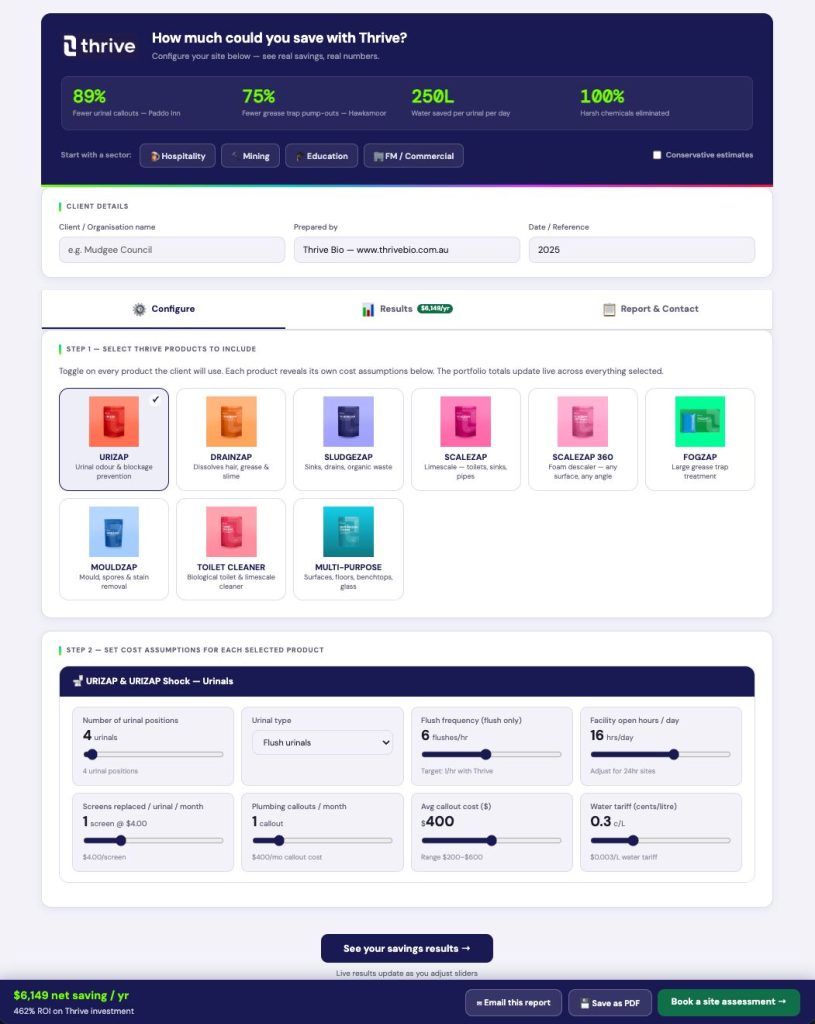
The calculator lets you configure your site and see your gross savings across every Thrive product relevant to your operation.
Here’s how it works:
Step 1 — Select your sector Choose from Hospitality, Mining, Education, or FM/Commercial. Each preset loads default assumptions drawn from real case study data, so you start with grounded numbers rather than generic estimates.
Step 2 — Configure your site Adjust sliders for your actual conditions: number of urinals, grease traps, drains, flush frequency, facility hours, callout frequency and cost. Every assumption is editable — the tool is only as useful as the inputs you put in.
Step 3 — See your savings The Results tab shows your gross annual savings broken across four categories: callouts and service visits eliminated, water savings, chemical products eliminated, and pump-out savings. A net saving figure and ROI percentage update live as you adjust.
Step 4 — Share the case Email the summary directly to your FM, CFO, or distributor. Download it as a PDF. Book a site assessment. The tool is designed to end with a conversation, not a dead end.
Who the calculator is built for
Hospitality operators — pubs, hotels, restaurants, and venues dealing with urinal odours, grease trap costs, drain maintenance, and limescale in high-traffic washrooms.
Mining and resources — remote sites where pump-out logistics are expensive, callouts are difficult, and sustainability reporting is increasingly mandatory.
Education — schools and universities with high-footfall washrooms, changing rooms prone to mould, and FM teams managing tight maintenance budgets.
Facilities management and commercial cleaning — FM operators managing multi-tenancy buildings, commercial cleaners looking for better outcomes and safer products for their staff.
Beyond the cost savings
The financial case is the headline. But there are three other dimensions that increasingly matter to our customers.
Staff safety. No bleach, no acid fumes, no caustic chemicals. Cleaning crews work without the PPE burden and without the health risks that come with conventional chemical products.
Sustainability reporting. Measurable water reduction. Zero chlorine or caustic chemicals entering wastewater. 100% biodegradable probiotic chemistry. For organisations with ESG commitments or sustainability KPIs, these are quantifiable contributions — not qualitative claims.
Operational resilience. Fewer reactive callouts means fewer disruptions to guests, customers, students, and staff. Preventive treatment keeps infrastructure in better condition for longer, reducing long-term capital costs.
Try it for your site
The Thrive Bio ROI Calculator is free, takes about two minutes to configure, and gives you a savings breakdown you can actually use.
If you’d like to talk through the numbers or arrange a site assessment, our team is ready.